


The Media Buying Tool and our projections are ready to win
We are gearing up for the General Election, and want to share two developments that we think will help us (and you, if you work with us!) be ready to execute maximally impactful paid media campaigns.
Build Weekly Programs in the Media Buying Tool
We are very excited to share that you can now build full weekly programs within the MBT!
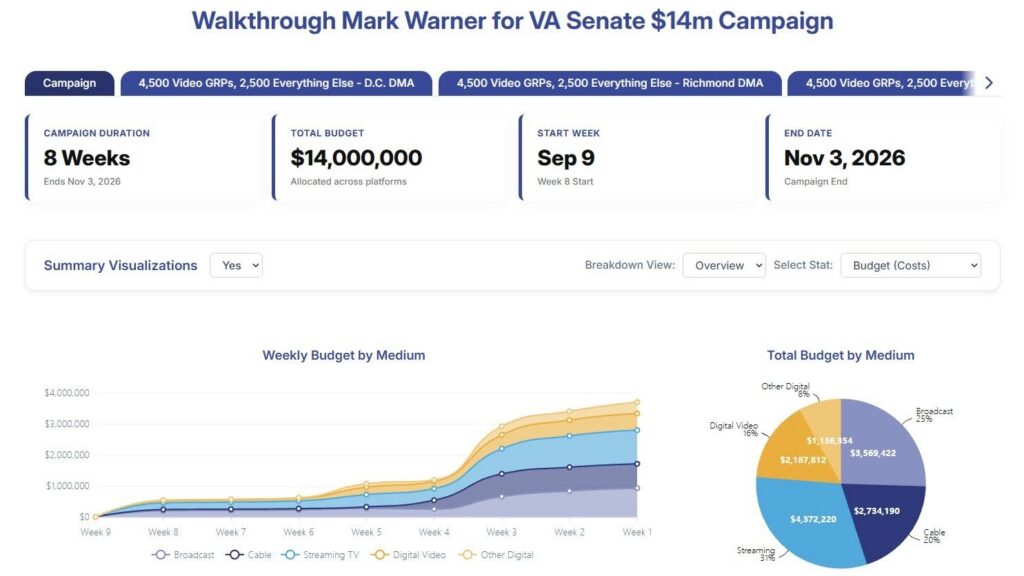
Here are a couple of samples:
- $400,000 Streaming and Digital State Senate Program
- $14 Million Multi-DMA Linear, Streaming, and Digital Statewide Program
In the upper-right hand corner, you can alternate between the “Campaign Visualization” view, which summarizes the plan over time, and the “Classic Weekly” view, which has both graphical visualizations and the full spreadsheet layout of budget by medium and platform each week. You can also drill down to weekly data at the individual plan level.
This is the final form of the MBT for the 2026 cycle, and we believe it will help folks better plan and communicate winning media programs. These weekly campaigns can be fully rebranded and customized, and will be free to use for folks who tap us for the General Election. You will also be able to export the data into a spreadsheet for manipulation into a different format, if you so desire.
If you’d like a walkthrough of this new tool functionality, or a link to a video that takes you through it, hit us up at Info@MediaBuyingTool.com and we will be in touch!
Using Our 2026 Primary Data to Update Projections for Pricing and Everything Else
Ultimately, the Media Buying Tool and any paid media program we or others deploy is only as effective as the data that powers it. In that vein, we want to share one final price and trends analysis with y’all, built off the big chunk of campaigns we’ve run in Primary Elections and elsewhere so far in 2026!
Since our last data, pricing, and trend review in March, we’ve deployed over $10 million across 138 unique campaigns, buying on 11 different Streaming/Digital ad auctions and utilizing another 4 media providers offering only direct buy relationships. So, we have a lot of data to sift through here to improve our projections and buying for the General Election. There have also been recent evolutions in key ad auctions worth breaking down. What are the biggest trends and takeaways we think you need to know about? The rest of this newsletter gets into them.
Reminder: All prices shared here are in-auction base prices, before media fees of any kind are added (buyer, partner, etc).
Significant Youtube Auction Evolution
In our March newsletter, we noted how Youtube prices dropped generally in 2025, despite the 30 second Non-Skippable ad type (aka a classic TV style ad that you have to watch all the way through) entering the auction. We bought a lot of 30s Non-Skip in the 2026 Primaries (in fact, it became easier to do so as Google pushed more auction updates throughout the first half of the year) and are seeing meaningful changes we want to share. The following data is from our Top 5 Youtube Spenders through the June 2026 Primaries – 3 highly contested congressionals and 2 highly contested large city mayorals – where we bought a significant amount of every kind of Youtube there is to be had.
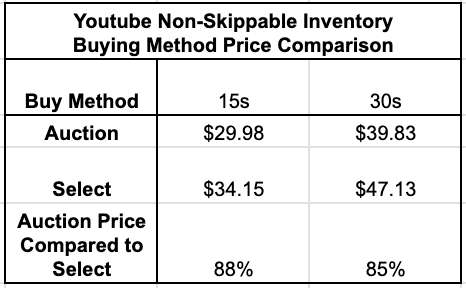
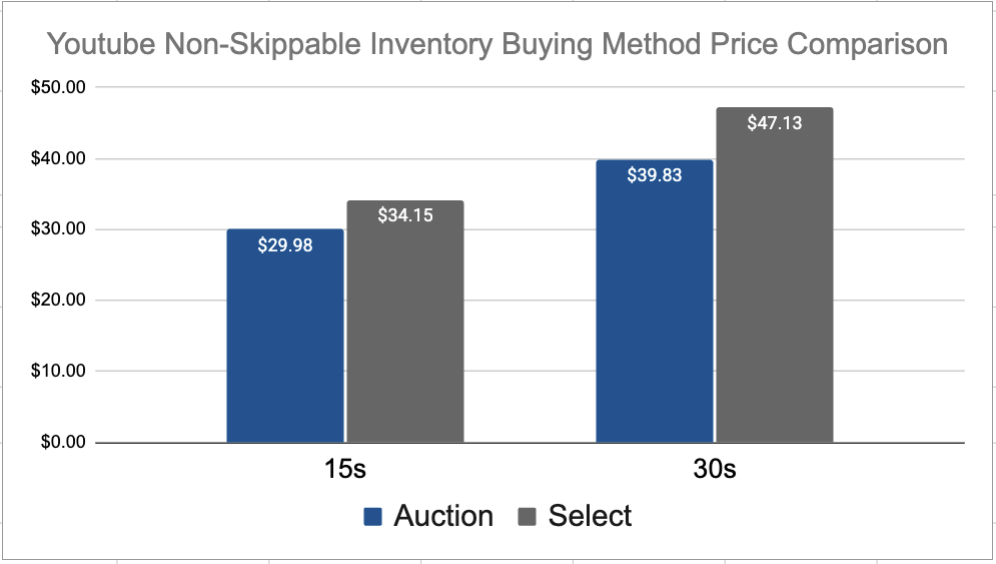
How does 30s Non-Skip auction price compare to Youtube Select, which was the only way to get this inventory type on Youtube until recently? The answer is significantly cheaper – ranging from 12% to 15% less for Auction than Select non-skip inventory depending on ad length. Advertisers also have more control in the auction than they do through Youtube Select, both in terms of targeting and pacing. Youtube Select certainly retains some advantages – for highly competitive races where locking up inventory early is a necessity, for Primary campaigns where some of the Premium Cable news inventory (MSNOW, CNN, etc.) that Google holds specifically for Select is extremely important, and for partners who place a heavy premium on getting as much 30s Non-Skip inventory as possible. But, for most campaigns that can’t guarantee $50,000 up front for Youtube Select, and for those who want us to be able to work our auction magic on 30s Non-Skip inventory, this is a welcome development.
With significant 30s Non-Skip now available in auctions, what do we think the right allocation of spend across media types for Youtube should be? The next table informs!
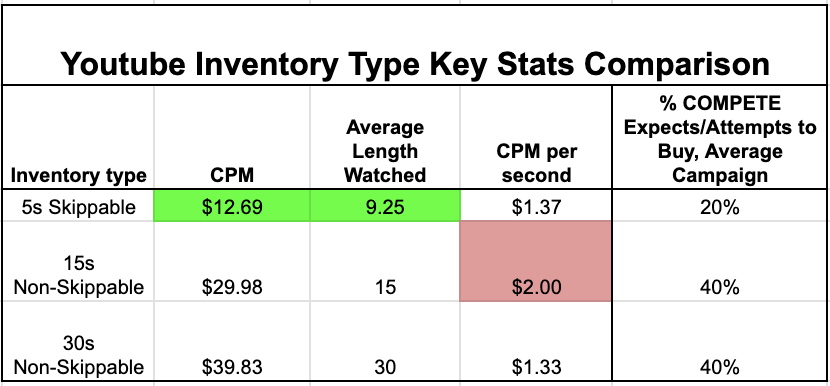
Some important inputs here:
- Buying some of all 3 types gives advertisers access to more total Youtube inventory/reach to target audiences, as well as lower aggregate prices, since we aren’t pushing the auction to spend more on a certain type of inventory than it would naturally. So, there is an inherent advantage to spreading the budget around.
- It is hard to spend the majority of Youtube budget on 30s Non-Skip inventory in the auction. You need a significant Youtube Select component to get above 50% (and even then, you end up with more 15s from Select than you might assume). Think about your average Youtube viewing experience – you don’t run into a ton of 30s Non-Skip ads. The auction reflects this, so 40% is the max we feel comfortable being able to plan to spend in the average competitive election on 30s Non-Skip.
- 15s Non-Skip’s “CPM Per Second” is unattractive compared to 30s Non-Skip and 5s Skip. However, since we aim for 80%+ of our buys to be on Non-Skippable media, and we can only buy a limited amount of 30s Non-Skip, we believe 15s Non-Skip should still command a good chunk of budget.
- Skippable inventory (aka 5s Skip because Youtube viewers can skip the ad after watching 5 seconds) experienced a price drop from 2025, while both types of Non-Skip inventory price increased. 5s Skip price is now 40% of 15s Non-Skip, and 30% of 30s Non-Skip. Additionally, 5s Skip “CPM per second” is much better than you’d think (see table above). Surprisingly, there are people who don’t immediately skip political ads after 5 seconds! So, we still think Skippable media deserves a seat at the table – albeit at a smaller % of the total budget.
All of this results in some significant changes to how we evaluate Youtube:
- More 30s Non-Skip means a higher CPM
- More “TV Quality inventory” means a higher Spot Value (important statistic in the Media Buying Tool for generating the Unified Gross Rating Point / URPs)
- A small expected “Saturation Rate” increase as a result of viewership trends (more on this in the next section!)
And in aggregate, we are adjusting our baseline YouTube buying strategy to
- offer a heavier 30s Non-Skip component
- recommend a higher % of total budget go to YouTube.
Then we have in the past.
TLDR: with increases in price and quality of inventory, ads on YouTube continue to morph into something closer to traditional Television than what they have been historically.
Viewers Watching More Streaming
In the competitive 2026 Primaries we bought in, we noticed that when we push Streaming ad auctions to buy more, they have been able to deliver more total media / budget per target audience member than they were able to in the past. This apparent inventory increase mirrors increases 2026 Streaming viewership reported by Nielsen:
Nielsen TV Watching Trends by Medium – Age 2+
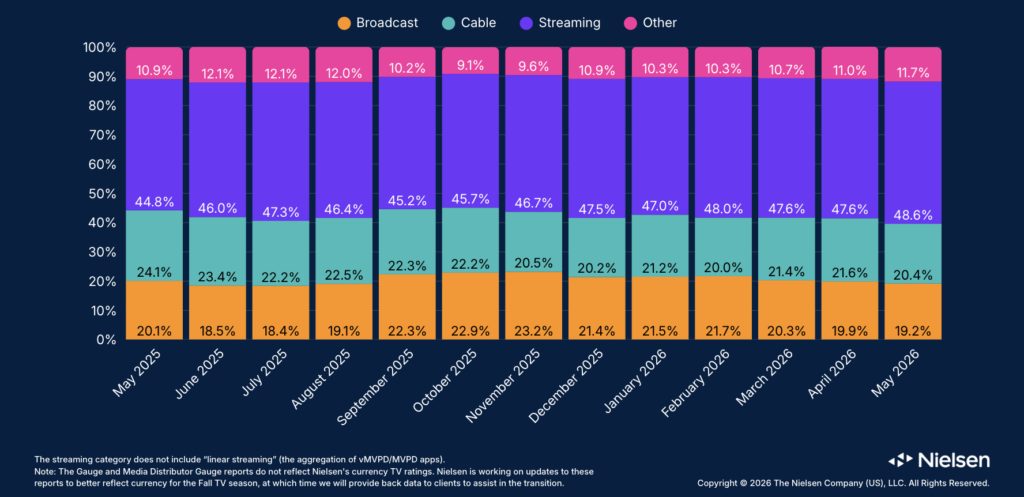
Youtube accounts for about half the increase in Streaming’s share of market, while “everything else” makes up the rest. The takeaway seems obvious: buy more Streaming and less Linear. But, we at COMPETE, a formerly “Digital first” firm making the shift to Omnichannel evaluator, are leery of this takeaway, as we are
- trying to make the best media type agnostic spend recommendations for our partners and campaigns
- mindful that Nielsen’s data is TV consumption by folks age 2+, while us political advertisers care about speaking to voters who are much older than that
- aware that a lot of smart folks in our vertical have won countless elections through the power of traditional television
Despite our reluctance, between what we’ve noticed in auctions and the Nielsen data, we believe a small increase in Streaming projected “Saturation rate”/market share is warranted, corresponding to an equivalently small decrease on Linear.
From a practical buying standpoint – how does this affect what ad platforms we should buy more of? Between Nielsen trends and improvements in their auction inventory quality, YouTube should command more impressions per target audience member than it was before. What other ad platform(s) are we giving a bump?
Roku Ads Continuing to Provide Huge Value
The Roku ads manager provides exclusively 15s Non-Skip and 30s Non-Skip Streaming TV inventory, across a desirable mix of Streaming media placements. Despite similar Spot Value/Inventory Quality as the other options for placing Streaming TV ads, it has historically offered a much lower CPM. Our 2026 data across all campaigns saw this trend continue, as Roku CPMs stayed flat while all other Streaming platform prices spiked.
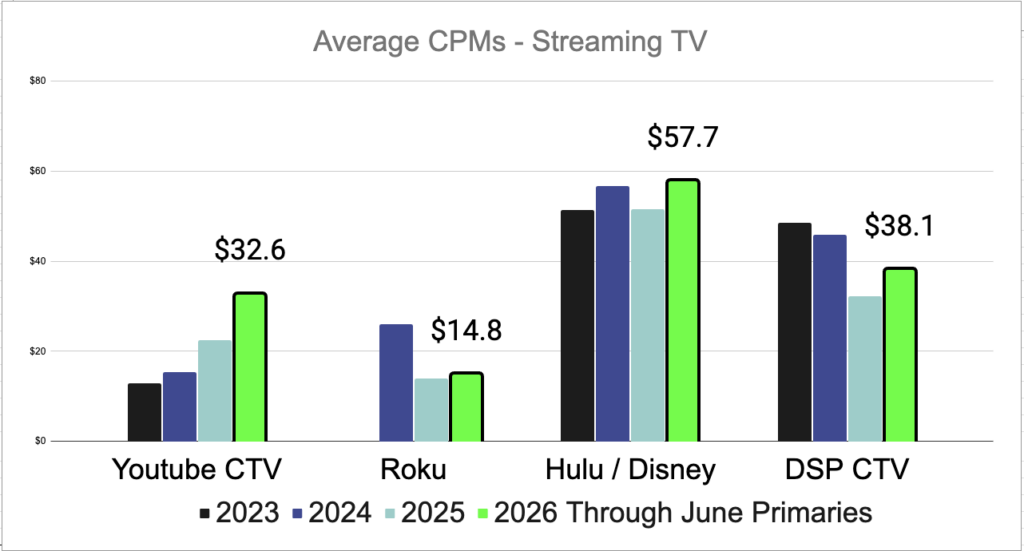
Put simply: Roku Ads offers the same quality of media as its competitors at ½ to ¼ the price. Sure, Roku often sits at the end of the “Waterfall” and typically gets media left over after linear, direct buy, PMP, and higher CPM DSP auctions have all grabbed a piece of the pie. But, with a price that good, we think it’s worth it to wait. Sometimes you’re the sucker if you buy first at a higher than necessary price!
So, to pay off the cliffhanger from the previous section – we’re allocating some of the Streaming TV market share increase to additional impressions per target on Roku. We see it as the highest value option for capitalizing on the increase in non-Youtube Streaming voter consumption.
Digital Radio Inventory Increasing Rapidly
Moving on from Streaming TV trends, we turn to the realm of Digital Radio, which has long befuddled and spurned political advertisers, resulting in less $$$ spent on this kind of media than one might think. In our estimation, this is a result of two main factors:
- Many Digital Radio providers did not take political money until recently
- Many Digital Radio providers were well behind Streaming, Internet, and Social media at getting their inventory hooked into modern ad auctions
Both 1) and 2) seem to be shifting, and we are finding that (with some but not all DSPs) more Digital Radio is obtainable in auctions than it has been in the past. Prices are coming in around $15 base CPM for 30s radio spots, often accompanied with a static banner – a nice plus. Additionally, more of the big providers, including iHeart and SiriusXM, are actively seeking direct buys with political advertisers, whereas in previous cycles they did not take political money.
Because of these changes, we are including Digital Radio in more plans we build for our partners. You can also add it to campaigns built in the Media Buying Tool.
Additionally, we are starting to see more ability to 1:1 target voter files on Digital Radio platforms. There are still scaling problems with this – 1:1 targeting for campaigns with audiences smaller than 100,000 spends very little – but it’s a strong step in the right direction. We are keeping our eye on how these scaling and targeting improvements evolve in our 2026 General Election data. There’s a chance that in 2027, if these positive trends continue, Digital Radio will get a boost in our media priorities/URP evaluations (URP being the acronym for Unified Gross Rating Points).
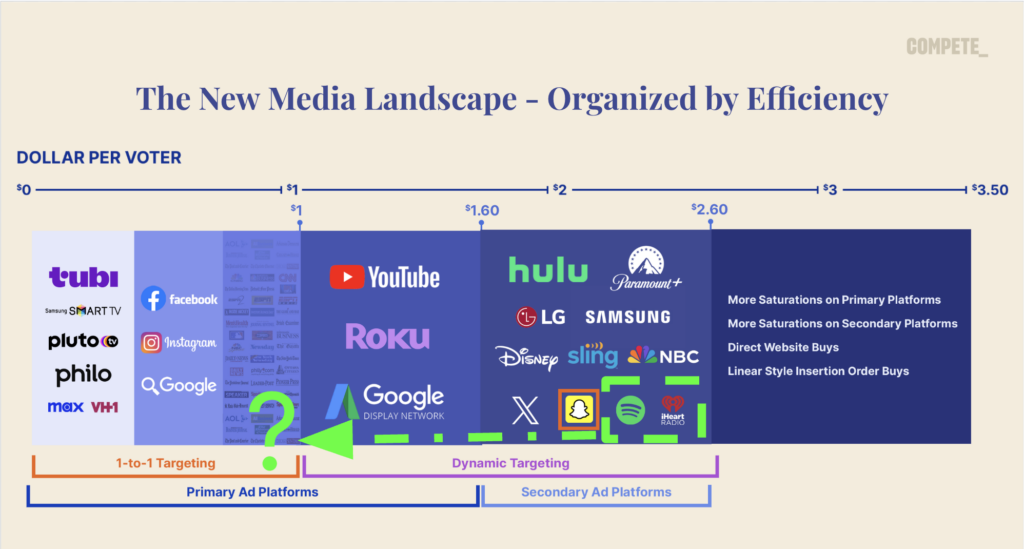
Digital Radio making moves up the budget priority landscape?
1:1 Targeted Digital Video Platform Prices Spike
The final trend we want to call out affects two of the higher ranking platforms in our efficiency landscape graphic from the previous section – Meta and Wider Web Preroll. These platforms make up the bulk of where we spend non-Streaming budgets for the average campaign, as they offer a strong combination of Price and Targeting Accuracy, which makes up for their significantly lower Spot Value than streaming inventory (so much great jargon from the Media Buying Tool! Confusing as it may be, we think these things matter when building the most effective buy).
We’ve been buying lots of both of these platforms since we started tracking data in 2020. Both Meta and PreRoll prices decreased in 2021 (good for advertisers!), and have stayed pretty low through last year. In 2026, for the first time in a while, prices for both Meta and Preroll spiked:
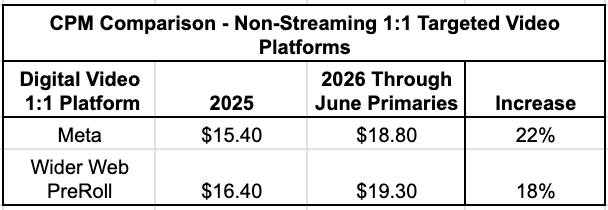
We think this increase may be partially driven by our unique 2026 Primary data, as we were buying to small target audiences in highly competitive primaries where 1:1 targeting is especially valuable (Primary electorates make up a much smaller % of the total 18+ population in their districts, so 1:1 targeting platforms become even more valuable since they waste the minimum number of impressions on non-Primary voters). Similar campaigns, with lots of $$$ per target to small audiences, will not be as common in General elections. Despite this, we do think the first significant price increase in some time is in order for Meta and PreRoll.
Wrap Up Data Dump
As is tradition with these brain-melting data dives – if you’ve made it this far, we applaud your zeal for the dirty details that we think have a huge impact on media buy efficiency! Below are tables and graphs with all of our historical data. With updated projections in hand and the Media Buying Tool fully formed, we stand ready for the General Election 🫡.
Are there trends you have noticed that you’d like to call our attention to? Do you want to quibble with any of our conclusions? Or perhaps you have an upcoming campaign that we could serve as a partner for you on? Please don’t hesitate to reach out to us at the contact info below.
If we don’t hear from you, good luck in November, and here’s hoping that we are reassured our democracy still works in a few months. We’ll see you on the other side.
Zach Mandelblatt
President
Zach@CompeteEverywhere.com
Pooja Patel
Director of Paid Media
Pooja@CompeteEverywhere.com